Transform the board
The placed stone can complete or break several intersecting lines at once.
Original elemental strategy game
One or two players · Web edition 1.0.4
Hold one stone. Exchange one stone. Bring Fire, Water, Earth, and Air into line.
RoleCreator and Game & Systems Designer — concept, elemental system, rules, iterative play development, and creative direction
The project
Ma’a began with a desire to play inside an elemental system—to make Fire, Water, Earth, Air, and Spirit determine how a game moves, not merely how it looks. I developed it over more than a year, repeatedly playing it with friends and family and refining the rules at the table.
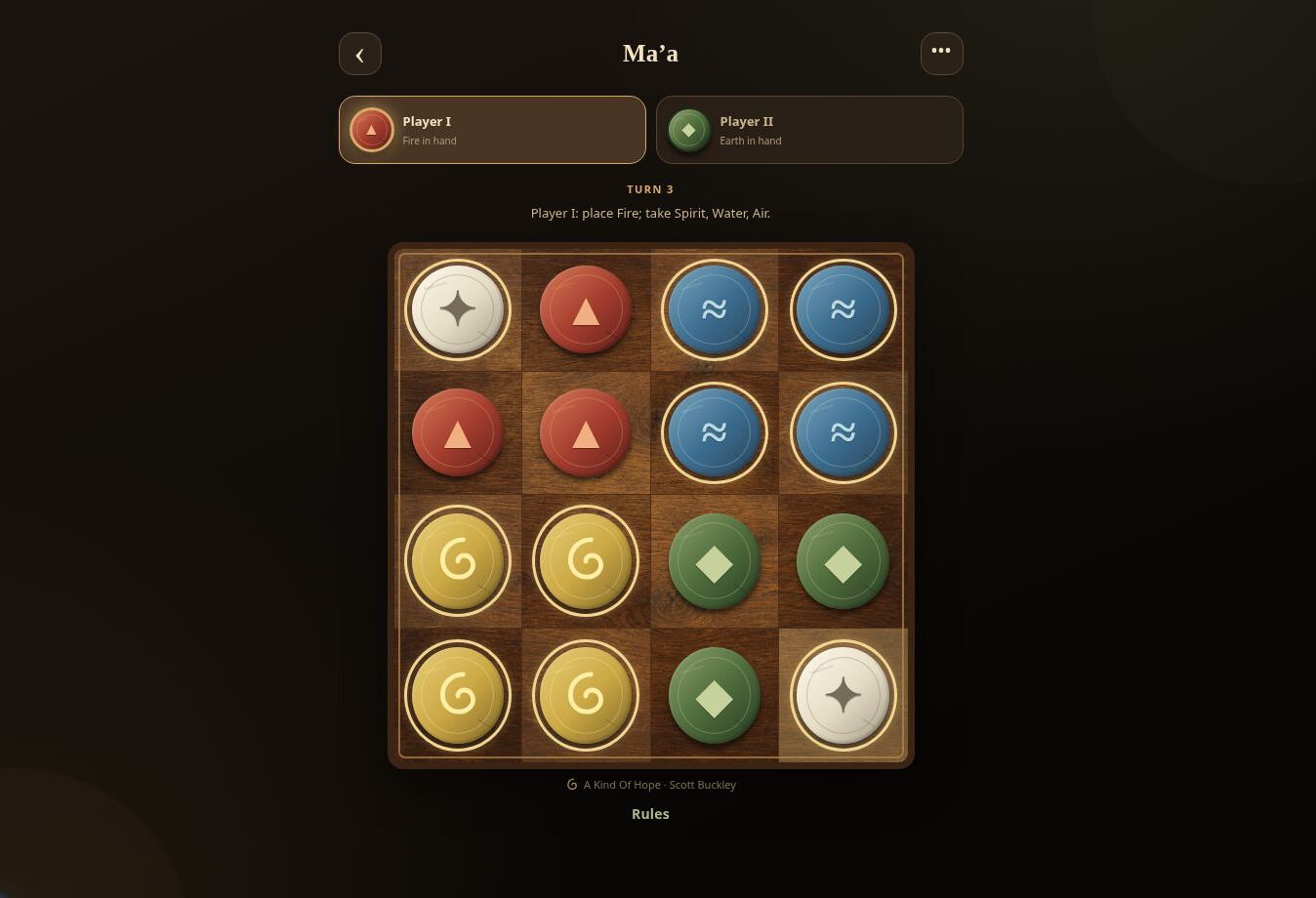
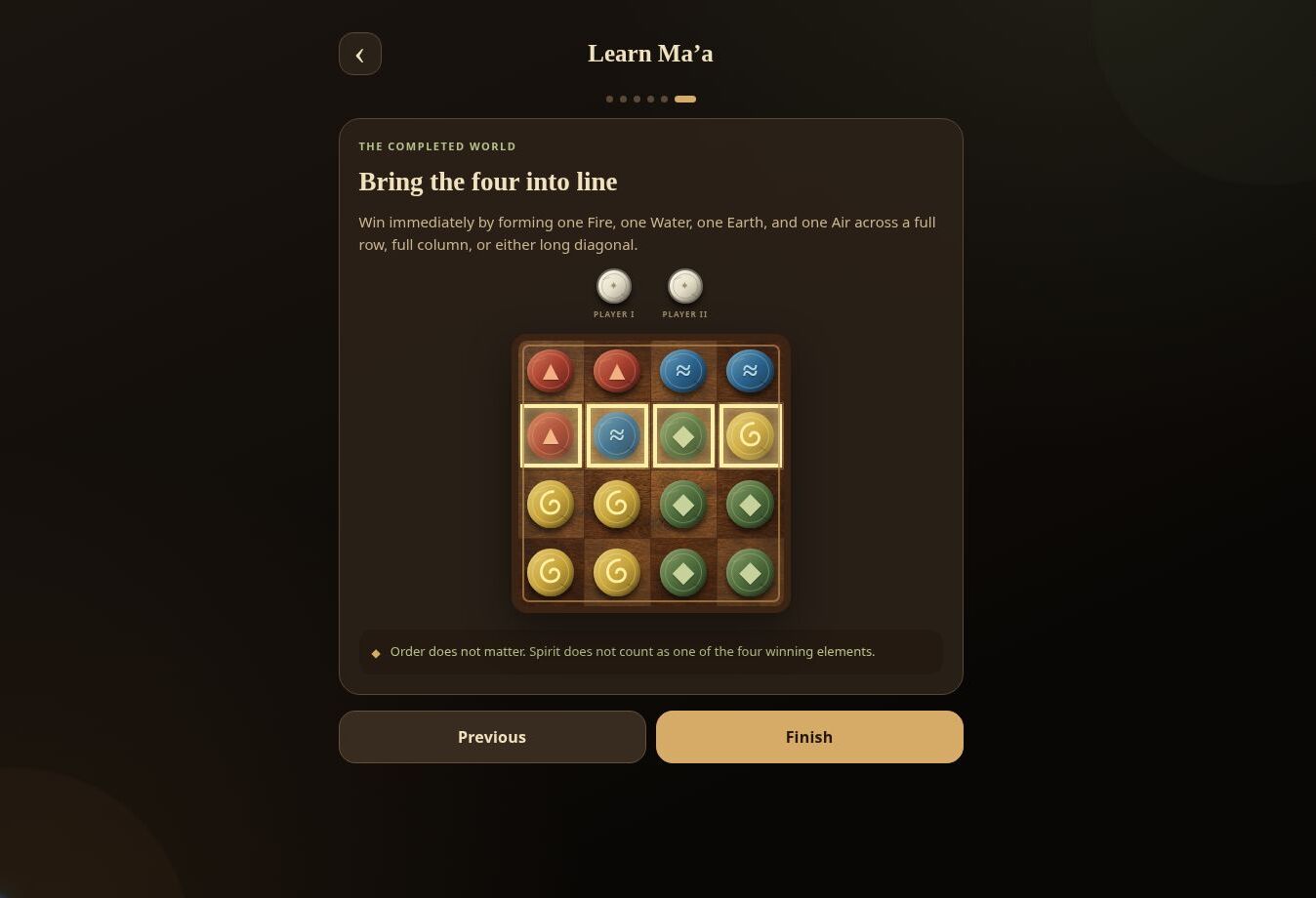
The result is a compact, complete-information strategy game played on a full 4×4 board. Sixteen elemental stones begin on the board, while each player holds a Spirit stone. On every turn, a player exchanges the stone in hand with one legal board stone; the displaced stone becomes the player’s next hand. The first player to form a row, column, or long diagonal containing Fire, Water, Earth, and Air wins.
My contribution
Design logic
Nothing is drawn, captured, discarded, created, or destroyed. Each exchange changes the shared board and determines the stone a player will carry into the next turn.
The placed stone can complete or break several intersecting lines at once.
The displaced stone becomes the player’s next resource, so choosing a target also shapes the following turn.
Victory requires four distinct earthly elements together. Spirit enables movement but cannot substitute for any of them.
The board and both hands remain visible. Strategy comes from sequencing and anticipation rather than hidden information, drawing, or capture.
Tools used
The full board, conserved stones, changing hands, exchange legality, and winning geometry operate as one compact engine.
The elements determine what can exchange and what counts as completion; their meaning is embedded in the rules.
Spatial alignment, hand management, open information, transformation, and elemental relationships resolve into one action.
Players win by bringing four different material elements into relation. Spirit connects them without replacing them.
Open the work
Play the complete one- or two-player web edition on phone, tablet, or desktop. It includes a guided tutorial and requires no account.
Credits & scope
Game concept, rules, elemental system, symbolic framework, and creative direction: Kyle Figard.
Developed over more than a year through repeated play with friends and family.
Web-edition interface and implementation: developed with AI assistance under Kyle Figard’s direction, specification, testing, iteration, and final approval.
Presented under Lady Lofn Games. Five Scott Buckley instrumentals are used under CC BY 4.0; complete links and modification disclosure appear in the game’s About section.
Next project